AI Search Optimization for Therapists: A 2026 Guide

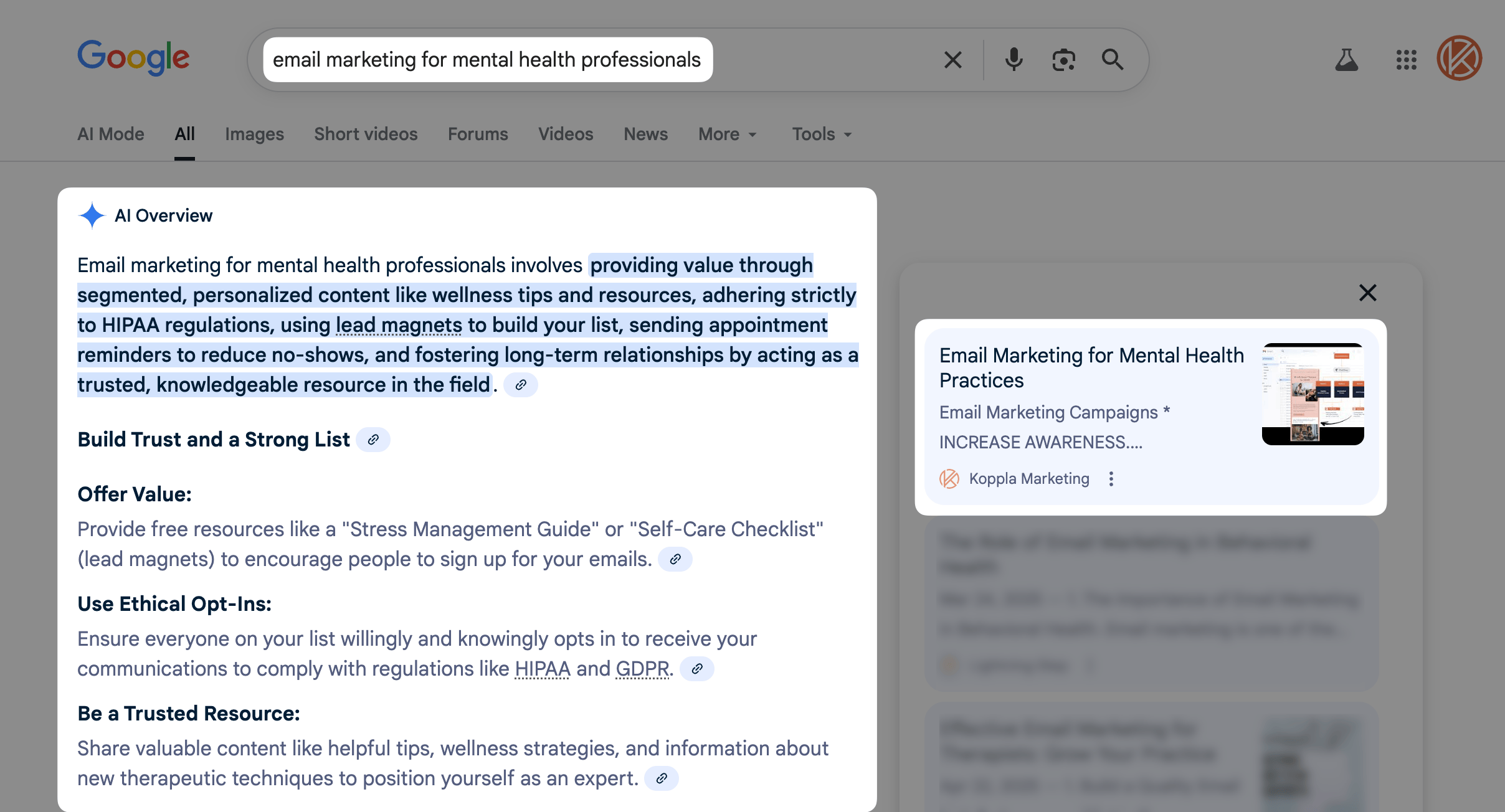
SEO for therapists is changing faster than ever before. Your potential clients aren't just typing queries into Google anymore. They're asking ChatGPT for therapy recommendations, consulting Perplexity about anxiety treatment options, and relying on Google's AI Overview to answer their mental health questions directly.
This shift means the SEO strategies that worked last year might not be enough today. While traditional search engine optimization focused on getting your website to rank higher in search results, a new approach called Generative Engine Optimization (GEO) focuses on making sure your expertise shows up in the AI-generated answers your clients are actually reading.
Key Takeaways
- AI answers now reach billions of monthly searches: Google's AI Overview appears for billions of queries each month, changing how people find therapists and mental health support
- Your content structure matters more than ever: AI systems look for clear, well-organized information with credible sources rather than just keywords
- Smaller practices can compete with larger organizations: Recent research shows these new optimization methods can increase your visibility by up to 40%, even if your website doesn't rank highly in traditional search
- Mental health content gets special treatment: Because therapy topics are sensitive and important, AI systems prioritize authoritative, well-cited content from qualified professionals
How GEO Benefits Mental Health Practices
Traditional SEO tried to get your practice's website to appear on the first page of search results. Generative Engine Optimization takes this further by making sure your expertise becomes part of the actual answer AI tools provide to users.
When someone asks ChatGPT "How do I find a trauma therapist near me who accepts insurance?" or types "signs I need therapy for anxiety" into Google, AI systems pull information from multiple sources to create a complete answer. Your practice needs to be one of those sources.
According to research from Princeton University and IIT Delhi, websites using these new optimization approaches saw their visibility improve by up to 40%. For mental health professionals who have always struggled against larger therapy directories and insurance company websites, this represents a real opportunity to get found by the clients who need your specific expertise.
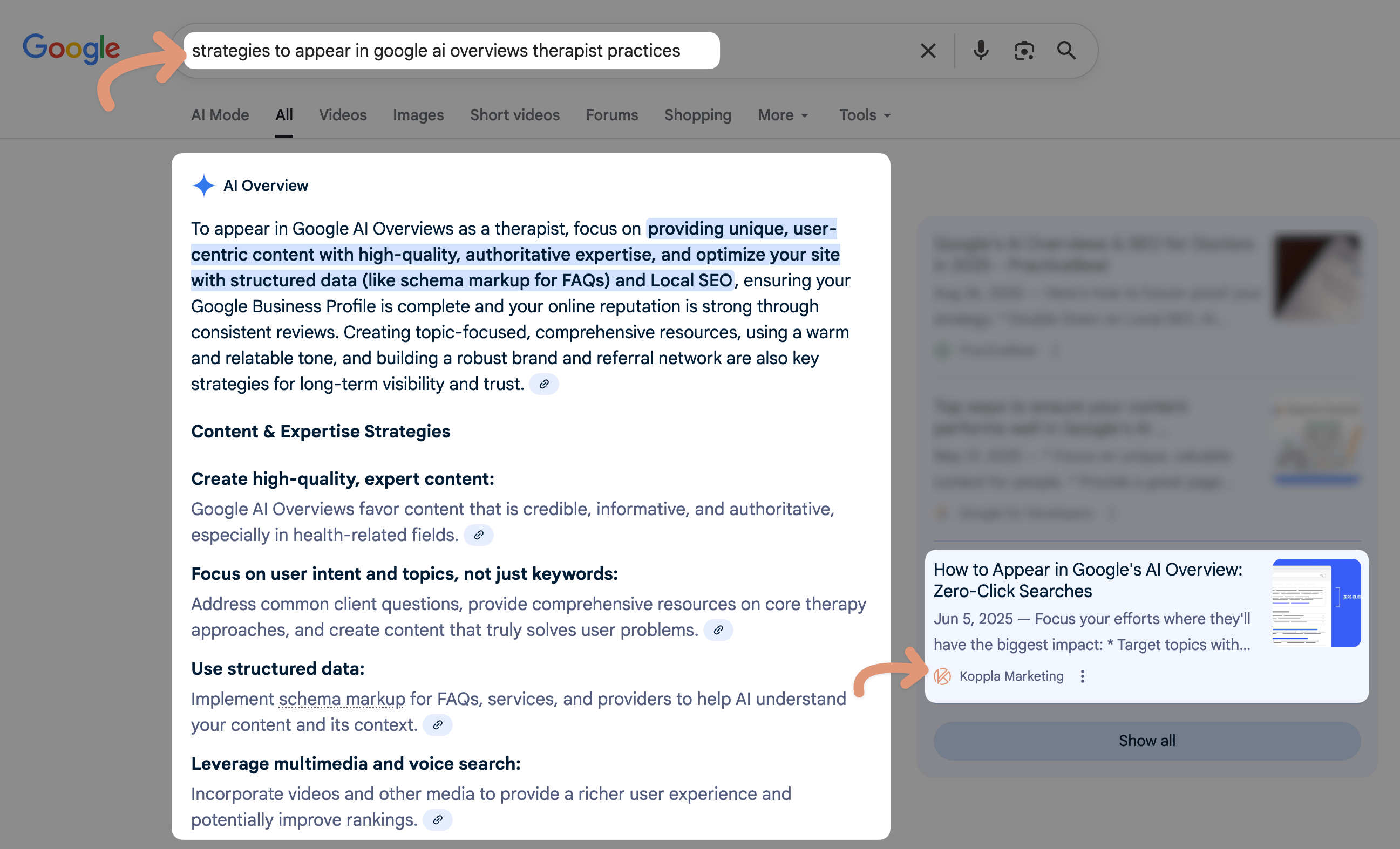
We practice what we teach. When therapists search for strategies to appear in google ai overviews therapist practices, our own content appears directly in Google's AI Overview. This isn't luck or chance. It's the result of applying these same principles we're sharing with you: creating authoritative, well-structured content that answers specific questions mental health professionals actually ask.
Why Mental Health Practices Need to Pay Attention
Healthcare and mental health face unique challenges online. According to a 2024 Statista study, approximately 15 million adults in the United States now use generative AI as their primary way to search for information online. These aren't people casually browsing. They're looking for answers to serious mental health questions at moments when they need guidance most.
Many therapists feel uncomfortable with the business side of running a practice. The good news is that GEO rewards exactly what you already do well: providing clear, compassionate, evidence-based information about mental health. Unlike traditional SEO, which often favored large organizations with thousands of website links, GEO focuses more on the quality and usefulness of your content.
How to Optimize Your Practice for AI Search
Build Clear, Logical Content Structure
AI systems need to understand your content before they can share it with users. This means organizing your website with clear headers, logical sections, and consistent formatting. Each page about a therapy service should answer specific questions in a predictable way: what the problem is, how you help, what clients can expect, and what makes your approach effective.
Your blog posts about managing anxiety or improving relationships become more valuable when they're formatted with clear introductions, practical strategies presented step-by-step, and helpful conclusions. Think of each piece of content as a complete answer to one specific question your ideal client might ask. Our guide on how to appear in Google's AI Overview provides detailed strategies for structuring your content so AI systems can easily extract and share your expertise.
Include Research and Evidence
Research shows that content with statistics and data sees 30 to 40% higher visibility in AI responses. For therapists, this means weaving relevant research findings into your content naturally. When you discuss treatment effectiveness, mention success rates from credible studies. When you explain different therapy approaches, reference the research that supports why they work.
You don't need to conduct your own studies. Simply citing existing research from sources like the American Psychological Association or peer-reviewed journals adds significant authority to your content in the eyes of AI systems.
Add Expert Perspectives
AI tools value content that demonstrates real expertise. Consider including relevant quotes or insights from colleagues, clinical supervisors, or recognized experts in specific areas (with their permission, of course). When writing about particular mental health conditions, reference perspectives from professionals who specialize in those areas.
This works especially well for group practices where different therapists can contribute their specialized knowledge to create comprehensive resources that cover topics from multiple angles.
Write for Real People, Not Algorithms
While maintaining clinical accuracy, make sure your content speaks to actual humans seeking help. AI systems favor content that balances expertise with accessibility. Complex therapeutic concepts should be explained in language that resonates with people at difficult moments in their lives, not just fellow clinicians.
Research indicates that improving how easy your content is to read can boost visibility by 15 to 30% in AI responses. This aligns perfectly with making mental health support accessible and understandable, which is probably why you became a therapist in the first place.
Creating this type of consistent, high-quality content doesn't have to overwhelm your schedule. The Create Once, Connect Often method shows you how to transform one comprehensive piece of content into multiple formats across different platforms, maximizing your reach while respecting your time as a busy clinician.
Putting This Into Practice
Start by looking at your current website content. Identify your most important pages (usually those discussing specific conditions you treat or therapy approaches you use) and apply these principles one at a time.
For each main service page, make sure you have:
- A clear problem statement using the words your clients would use to describe their struggles
- Evidence-based information with proper citations to credible sources
- Your specific therapeutic approach explained in accessible terms
- Structured formatting that helps both humans and AI understand your expertise
Next, create content that answers the specific questions your ideal clients ask AI tools. Instead of general posts about mental health awareness, write targeted pieces addressing real queries like "What happens in my first EMDR session?" or "How do I know if I need trauma therapy versus regular counseling?"
If you're wondering what specific topics to write about, our list of 40+ blog topic ideas for therapists groups topics by the reasons people give for putting off therapy, such as cost and not knowing where to start.
Pay attention to which mental health topics generate the most AI-assisted searches in your area of expertise. A handful of tools now track how often AI tools cite your content, though the space is still young and changing fast.
Maintaining Professional Standards
As mental health professionals, you have responsibilities that go beyond visibility. Make sure every statistic you cite comes from reputable sources. Avoid sensationalizing mental health conditions just to get attention. Keep appropriate boundaries about what belongs on your public website versus what should stay within the therapeutic relationship.
Remember that AI systems might present your content to vulnerable people in crisis. Every piece of content you optimize should reflect the same ethical standards you maintain in your practice.
Common Questions About AI Search for Therapy Practices
What is AI search optimization for local therapy practices?
It's the work of making your practice one of the sources AI tools pull from when someone asks about therapy. When a client asks ChatGPT, Perplexity, or Google's AI Overview a question like "how do I find a trauma therapist near me," those tools assemble an answer from content across the web. AI search optimization means structuring your site and content, your service pages, condition explainers, and FAQs, so your expertise gets cited in that answer instead of being skipped over.
How do you optimize a therapy website for AI search queries?
Write each page as a complete answer to one specific question a client would ask. Use clear headers, short sections, and plain language. State the problem in the words clients use, explain how you help, and back claims with citations to credible sources like the American Psychological Association or peer-reviewed research. Add schema markup so machines can read your specialty, credentials, and location. Pages built this way are easier for AI systems to extract and quote.
What content helps therapy practices rank in AI search results?
Specific, question-based content does the heavy lifting: condition guides, treatment explainers, and FAQ pages that answer real client questions like "What happens in my first EMDR session?" or "How do I know if I need trauma therapy?" Content with data and citations sees meaningfully higher visibility in AI responses, so weave in research where it fits. Broad, generic posts about mental health awareness rarely get cited.
Why should therapists care about AI visibility in 2026?
Because a growing share of clients now start with an AI tool instead of a list of blue links. Roughly 15 million U.S. adults already use generative AI as their main way to search. If your practice isn't part of the answers those tools generate, you're invisible to those people, no matter how good your website is. Acting early matters because most therapy directories haven't adapted yet, which leaves room for individual practices to get cited.
How do therapy practices build authority in AI-generated search results?
The same way you build trust with a client: demonstrate real expertise, cite credible sources, and be transparent about credentials. AI systems lean on authoritative, well-cited content for sensitive health topics. Show your license and specialties clearly, reference current research, and publish consistent, accurate content in your areas of focus. Over time, that track record is what makes AI tools treat you as a reliable source worth quoting.
The Bigger Picture
This shift toward AI-powered search is more than a technical change in how SEO works. It's an opportunity to make mental health resources more discoverable for the people who need them most. As AI tools become the primary way people seek health information, practices that adapt their online presence will be best positioned to serve their communities.
The therapists implementing these strategies now are building the foundation for how mental health services will be discovered in the future. By focusing on creating authoritative, well-structured content that serves both AI systems and real people, you can make sure your expertise reaches those seeking support, no matter how they choose to search.
Ready to Adapt Your Practice's Online Presence?
At Koppla Marketing, we help mental health professionals navigate all aspects of digital strategy and marketing. Our team understands both the technical side of modern SEO and the unique ethical considerations of marketing mental health services.
We can help you build an online presence that connects with both AI systems and the clients who need your expertise. Contact us or schedule a free consultation to explore how these new optimization approaches can improve your practice's visibility while maintaining the therapeutic integrity at the heart of your work.
Sources
Google AI Overview Usage Statistics:
- Digiday. (2025). Google's AI Overviews reach over 2 billion monthly users.
https://digiday.com/media/googles-ai-overviews-reach-over-2-billion-monthly-users/ - TechCrunch. (2025). Google's AI Overviews have 2B monthly users, AI Mode 100M in the US and India. https://techcrunch.com/2025/07/23/googles-ai-overviews-have-2b-monthly-users-ai-mode-100m-in-the-us-and-india/
Generative Engine Optimization Research:
- Narayanan Aiyer, P., et al. (2023). GEO: Generative Engine Optimization. arXiv preprint arXiv:2311.09735.
https://arxiv.org/pdf/2311.09735.pdf - Princeton University. (2024). GEO: Generative Engine Optimization.
https://collaborate.princeton.edu/en/publications/geo-generative-engine-optimization - Search Engine Journal. (2024). Researchers discover how to SEO for AI search.
https://www.searchenginejournal.com/researchers-show-how-to-rank-in-ai-search/504260/